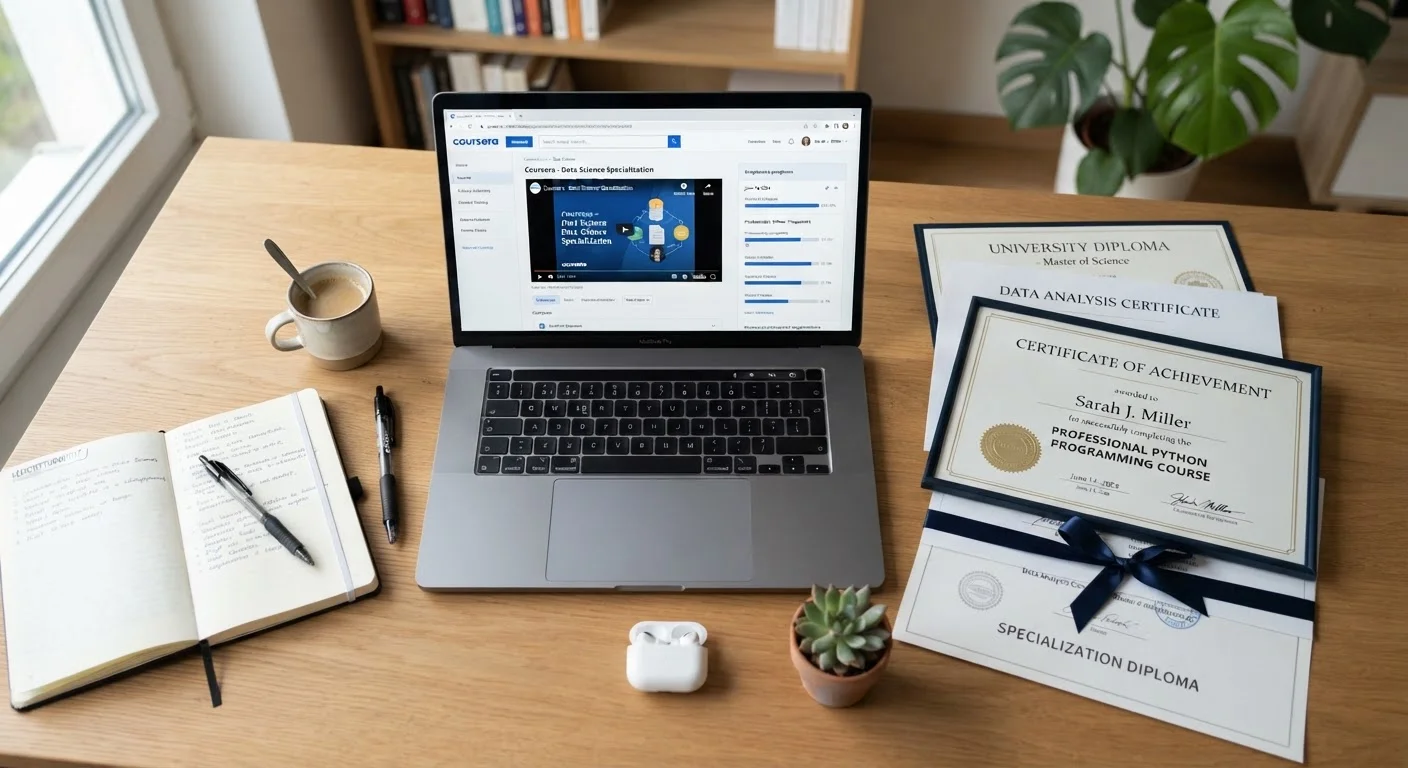


What free courses actually include
Free online courses vary more than most people expect. On some platforms, a free enrollment gives you full access to video lectures, reading materials, and quizzes. On others, free access is an audit mode: you can watch lectures but cannot submit assignments or receive a certificate.
The consistent limitation across nearly all free tiers is credentialing. Completing a free course almost never produces a shareable certificate with the weight needed for a job application or promotion review. Some platforms do issue free certificates of completion, but these carry no external verification and differ from accredited credentials. For more on what those terms mean, see how certificates and credentials differ before assuming any certificate has career value.
Instructor access is also limited or absent in free tiers. Discussion forums may be open, but direct feedback on your work is generally reserved for paying learners. That gap matters for technical subjects where misunderstanding a concept early can compound later.
Despite those limits, free courses work well for building a mental map of a field, confirming whether a subject interests you, and learning concepts you intend to apply immediately on your own. Self-directed learners in particular tend to get strong results from free content. The self-directed learning model suits people who can set their own checkpoints and do not depend on external grading to stay on track.
What paid courses actually include
Paid online courses differ from free ones primarily in structure, accountability, and documented outcomes. The cost buys you more than content; it typically buys graded assessments, instructor or peer feedback, and a certificate that can be verified by a third party.
Structured assessments matter because they force application, not just passive watching. A paid course in data analysis, for example, might require you to submit a project, receive rubric-based feedback, and revise your work. That process builds a skill in ways that watching the same lecture for free does not.
| Criterion | Free online courses | Paid online courses |
|---|---|---|
| Content access | Often full lectures and readings | Full curriculum with structured path |
| Graded assessments | Rarely included | Standard in most paid tiers |
| Instructor feedback | Not typically available | Included or available as add-on |
| Certificate on completion | Uncommon; rarely verifiable | Standard; often shareable or accredited |
| Accountability structures | Self-paced, no external deadlines | Cohort schedules or progress checkpoints |
| Cost | No charge | Varies widely by platform and course |
| Best use case | Exploration and foundational learning | Credentialing and skill documentation |
Certificates from paid courses range from simple completion records to accredited academic credit. The difference is significant for career use. Before enrolling, it is worth reading about the distinctions between online qualifications so you understand what credential you are actually purchasing.
Support structures, including cohort schedules, live Q&A sessions, and mentorship options, also tend to sit behind a paywall. These are not decorative additions. Learners who complete courses at higher rates often point to accountability structures as the reason they finished.
Before committing to any paid course, use a pre-enrollment checklist to verify instructor credentials, accreditation status, and refund policies. The course evaluation checklist covers the questions worth asking before you pay.
How to decide which fits your situation
The right choice depends on what you need the learning to do. If the goal is personal enrichment, satisfying curiosity, or previewing a field, a free course is a reasonable starting point with no downside. If the goal is a credential that signals competency to an employer, a paid course is almost always necessary.
Consider the format question alongside the cost question. A paid course delivered entirely as pre-recorded video with no feedback structure may offer less learning value than a well-designed free course with active forums and peer exercises. Cost and quality are not the same variable. See the comparison of synchronous versus asynchronous formats for a related set of trade-offs that affect how much you retain, regardless of what you paid.
One practical approach: audit the free version of a course first. Many platforms that charge for certificates allow free audit access to the full curriculum. If the content and instructor style suit you after two or three modules, you can upgrade to the paid tier with more confidence. That sequence avoids spending money on a course whose depth or approach does not match what you need.
For a structured way to work through this decision, the pre-enrollment checklist walks through the questions of goal alignment, schedule fit, and credential value before you commit.