
Why dog owners keep questioning commercial kibble
Dry kibble has fed tens of millions of American dogs for decades, and the arguments for it are straightforward: it meets AAFCO nutritional standards, stores easily, and costs less per serving than the alternatives. Yet owner interest in raw and fresh-cooked diets has grown considerably, driven partly by a broader consumer interest in whole ingredients and partly by frustration after high-profile pet food recalls.
The skepticism is understandable, but it does not mean kibble is nutritionally inferior by default. AAFCO-compliant formulas must meet defined minimums for protein, fat, vitamins, and minerals for the stated life stage. The gap between a well-formulated kibble and a poorly constructed home-cooked diet can be large, and the dog almost always loses that comparison. For owners weighing their options, the goal is not which approach sounds most natural but which one actually delivers complete and balanced nutrition consistently. See common dog nutrition myths for a closer look at how marketing language can distort feeding decisions.
What each feeding approach actually involves
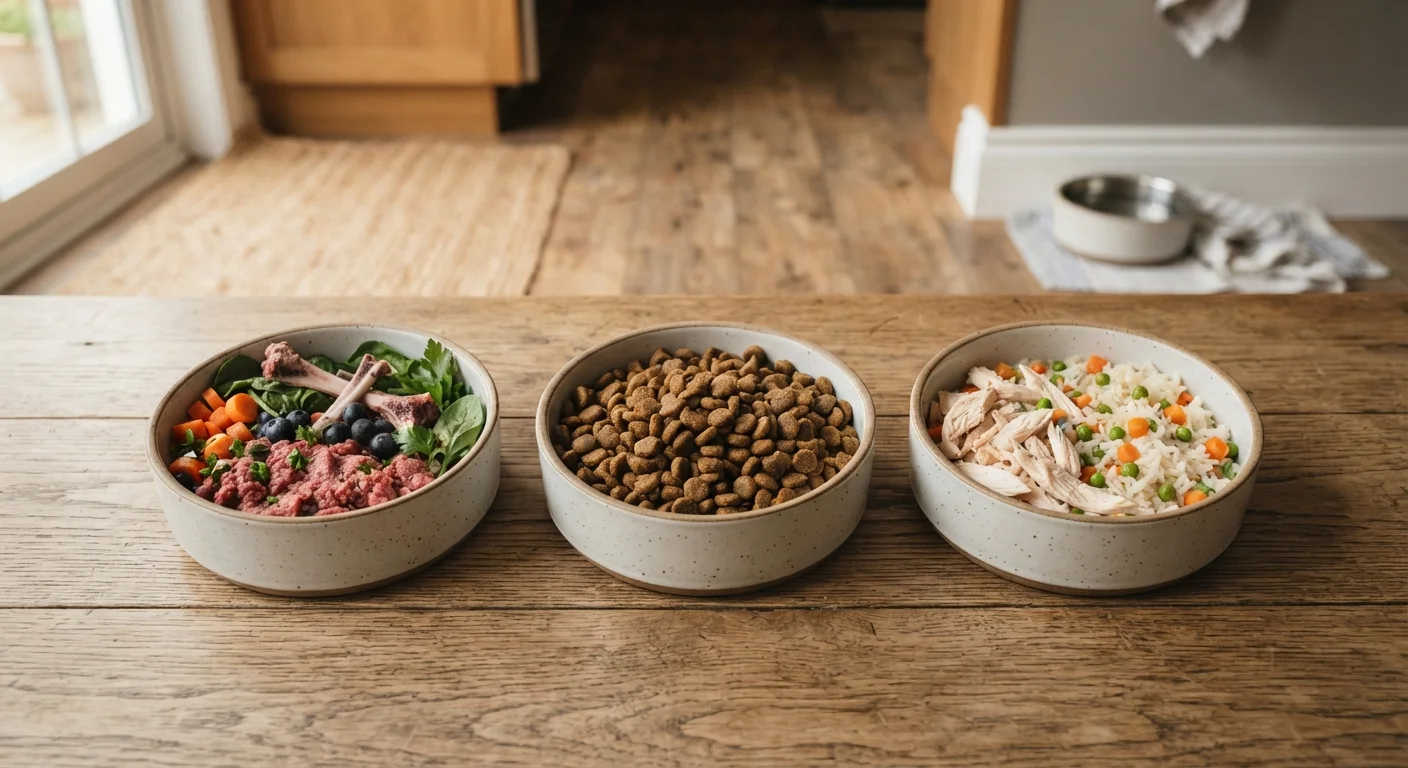
Kibble is extruded, dried, and preserved to last months without refrigeration. Most commercial formulas are designed to serve as a complete diet with no supplementation needed. The processing does reduce some heat-sensitive nutrients, but reputable manufacturers account for this in formulation. Palatability varies by dog; some animals refuse dry food or do better with hydration added.
Raw diets (often called BARF, which stands for Biologically Appropriate Raw Food, or whole prey models) typically include uncooked muscle meat, organ meat, raw meaty bones, and sometimes raw vegetables or eggs. Proponents argue that cooking destroys enzymes and alters protein structure in ways that reduce digestibility. The evidence does not consistently support that claim. What is well-documented is the bacterial risk: raw meat frequently contains Salmonella, Listeria, and E. coli, which can shed in a dog's feces and contaminate surfaces in the home. The AVMA discourages raw feeding specifically because of this cross-contamination risk to people, especially children, elderly individuals, and immunocompromised household members.
Fresh-cooked diets sit between the two. Cooking reduces pathogen risk substantially. When a recipe is formulated by a board-certified veterinary nutritionist, a fresh-cooked diet can meet AAFCO nutrient profiles. The challenge is that most home recipes circulating online have not been independently analyzed and are frequently deficient in calcium, zinc, or specific vitamins. Without supplementation matched to the recipe, nutritional deficiencies develop gradually and may not appear as obvious symptoms until significant harm has occurred.
| Kibble | Raw diet | Fresh-cooked | |
|---|---|---|---|
| Nutritional completeness | Reliable if AAFCO-compliant | Often incomplete without expert formulation | Complete only if professionally formulated |
| Bacterial safety risk | Very low | High (Salmonella, Listeria, E. coli) | Low when cooked thoroughly |
| Cost | Lowest per serving | Moderate to high | Moderate to high |
| Preparation time | Minimal | Significant (thawing, handling) | Significant (cooking, portioning) |
| Storage requirements | Pantry, months-long shelf life | Freezer space required | Refrigeration, 3-4 day shelf life |
| Vet/AVMA support | Broadly supported | Generally discouraged | Supported with proper formulation |
Safety and practical considerations
Food safety is not the only practical variable. Cost and time matter too. Kibble costs the least per calorie for most dog sizes. Fresh-cooked meals require ingredient sourcing, preparation time, refrigeration, and the ongoing cost of any prescribed supplements. Raw diets add freezer space, careful thawing protocols, dedicated cutting boards and utensils, and thorough hand-washing after every feeding. Households with young children or anyone with a compromised immune system face meaningful risk with raw feeding regardless of how carefully it is managed.
Bone safety is a separate issue. Raw meaty bones are often promoted as natural dental cleaners, and there is some evidence that gnawing on appropriate raw bones can reduce tartar. However, bones that are too small, too brittle, or cut the wrong way can splinter, causing oral lacerations, intestinal obstruction, or perforation. Cooked bones of any kind are more brittle and should never be given. Dental hygiene options that carry less risk include enzymatic toothpaste and vet-approved dental chews.
Transitioning diets gradually
Switching foods abruptly can cause vomiting or diarrhea even when the new diet is nutritionally sound. Mix 25% of the new food with 75% of the old food for two to three days, then shift to 50/50, then 75/25, and finally 100% new food. If digestive upset persists beyond a week, contact your veterinarian.
Dogs switching diets often experience digestive upset during the transition. A slow changeover over seven to ten days, mixing increasing amounts of the new food with decreasing amounts of the old, reduces that risk regardless of which direction the change goes.
What vets generally recommend
Veterinary consensus, including guidance from the AVMA and the ACVN, favors commercially prepared diets that carry an AAFCO statement of nutritional adequacy for the dog's life stage. That does not mean fresh-cooked diets are dismissed; it means the bar for getting them right is higher than most owners realize.
If a dog has a documented food allergy, a chronic condition, or a health profile that makes standard commercial food difficult, a veterinary nutritionist can design a recipe that accounts for those needs precisely. This is different from using a recipe found on a pet blog or even from a general-practice vet who has not specialized in nutrition. Nutritional analysis of home-cooked recipes costs money, but it is the only way to know whether the diet is actually complete.
For a dog without specific health conditions, a high-quality kibble or a formulated fresh-cooked option are both defensible choices. The annual wellness visit is the right time to discuss diet with your vet, assess body condition score, and adjust feeding amounts as the dog ages. If you are bringing a dog home for the first time, establishing a feeding routine early is one of the more useful things you can do for long-term health.
This article is for general informational purposes only and is not a substitute for professional veterinary advice. Consult a licensed veterinarian or board-certified veterinary nutritionist before making significant changes to your dog's diet.