
Why cat body language is worth learning
Cats communicate almost entirely through body language. Unlike dogs, they rarely use vocalizations to signal mood to other cats; meowing is largely reserved for humans. That means the tail, ears, eyes, posture, and whisker position your cat displays throughout the day carry far more information than any sound they make.
Misreading those signals is a common source of bites, scratches, and damaged trust between cats and their owners. A tail flick that looks playful is often the opposite. A slow blink that seems sleepy is actually a gesture of comfort. Getting these details right changes how you interact with your cat and how your cat responds to you.
For more on how feline behavior connects to specific habits, see our guide on why cats knock things off tables for a closer look at attention-seeking and environmental signaling.
Piloerection
The involuntary raising of fur along the back and tail, caused by the same reflex that produces goosebumps in humans. In cats, it signals fear or perceived threat, not aggression.
Bunting
The act of pressing the forehead or cheek against a person or object to deposit scent from facial glands. It marks familiarity and social bonding.
Slow blink
A deliberate, unhurried closing and opening of the eyes that cats use to signal they feel safe and at ease. It can be directed at other cats or at humans.
Airplane ears
A colloquial term for ears rotated sideways and flattened, indicating that a cat is moving from discomfort toward fear or defensive aggression.
Reading the tail
The tail is the most readable part of a cat's body at a distance. Its position and movement together tell you where your cat is emotionally.
- Tail held high, tip slightly curled: confident and content, often a greeting signal toward a person or familiar animal.
- Tail puffed out (piloerection): the cat feels threatened or frightened. This is not aggression but a defensive response to perceived danger.
- Tail low or tucked between the legs: anxiety or submission. A cat in this posture wants distance, not interaction.
- Slow, wide sweeping wag: frustration or conflict. This is not the happy wag of a dog. Give the cat space.
- Quick, sharp flicking at the tip: irritation building. Stop petting or engaging immediately.
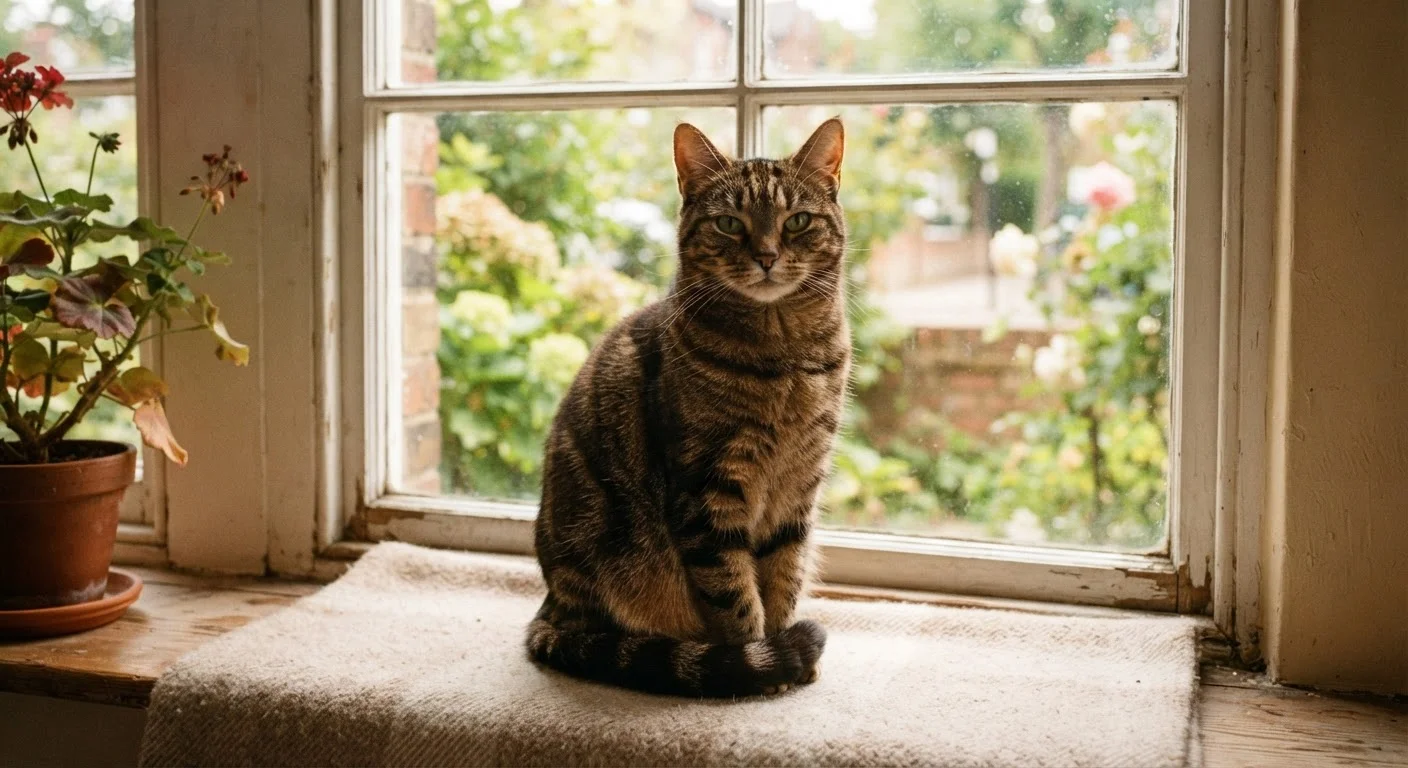
A tail wrapped around another cat or around your leg is a social bonding gesture, equivalent in meaning to a light touch between friends.
Ears and eyes
Ear position changes fast and is one of the earliest indicators of a mood shift.
- Ears forward and slightly outward: alert, curious, engaged.
- Ears flat and rotated sideways (called airplane ears): fear or aggression is building. Back off before the cat escalates.
- Ears pinned back tight against the skull: the cat is about to defend itself. Do not reach toward it.
Eye signals are equally informative. Dilated pupils in normal light suggest excitement, fear, or high arousal. Constricted pupils in low light suggest confidence, irritation, or mild threat. A direct, unblinking stare at another cat is a challenge. Directed at you, it can mean the same unless paired with other relaxed signals.
The slow blink is the most misunderstood eye behavior. When a cat looks at you and blinks slowly, it is communicating that it does not feel threatened and is comfortable in your presence. You can return the gesture. Many cats will respond by blinking again or looking away, both of which signal trust rather than disinterest.
| Primary communication channel | Body language (posture, tail, ears, eyes) |
| Meowing directed at | Humans almost exclusively, not other cats |
| Slow blink meaning | Trust and comfort, not sleepiness |
| Tail flicking quickly at the tip | Building irritation, a stop-now signal |
| Belly exposure | Relaxation and trust, not a petting invitation |
| Ears pinned flat to skull | Imminent defensive response, disengage immediately |
Posture and full-body signals
Reading individual features in isolation gives you part of the picture. Full-body posture gives you the whole one.
- Cat rolled onto its back, belly exposed: relaxed and trusting, but not necessarily an invitation to touch. Many cats that expose their belly will swipe if you reach for it. Observe other signals before responding.
- Crouching low with head tucked: the cat feels unsafe. It is preparing to flee or, if cornered, to fight.
- Loaf position (paws tucked under the body): calm and comfortable. A cat in this posture is not on alert.
- Head bump (bunting): the cat is depositing scent from facial glands onto you. It is a claim of familiarity, not just affection.
- Kneading (making biscuits): a behavior carried from kittenhood, linked to comfort and security.
When you bring a new cat home, recognizing these posture signals early helps you give the animal the space it needs to settle. Our guide to setting up a home for a new cat covers how the physical environment affects feline confidence and stress.
Scratching behavior is another body-language-adjacent habit worth understanding. See when cat scratching becomes a problem for context on what the behavior communicates and how to work with it.