
Why tires matter more than most drivers realize
Tires are the only part of your vehicle that contacts the road. Braking distance, cornering grip, and how well your car handles rain or ice all depend on those four contact patches. Yet tires are easy to ignore because they degrade slowly and rarely announce a problem until one becomes serious.
Poor tire condition affects more than safety. Underinflated or unevenly worn tires reduce fuel economy and can shorten the life of suspension components by transmitting more road shock into the chassis. For context on how tire care fits into the bigger picture, see your car's full maintenance schedule.
The good news: the three core tasks covered here require no special mechanical skill, take only a few minutes each, and have a direct, measurable effect on how your vehicle performs.
How to check and set tire pressure correctly
Tire pressure is measured in PSI (pounds per square inch). The target figure for your vehicle is printed on a sticker inside the driver's door jamb or in the owner's manual. Do not use the number molded into the tire sidewall; that is the tire's maximum rated pressure, not a driving target.
Check pressure when the tires are cold, meaning the car has been parked for at least three hours or driven fewer than a mile. Driving warms the air inside the tire and raises the reading.
- Remove the valve cap from the tire stem.
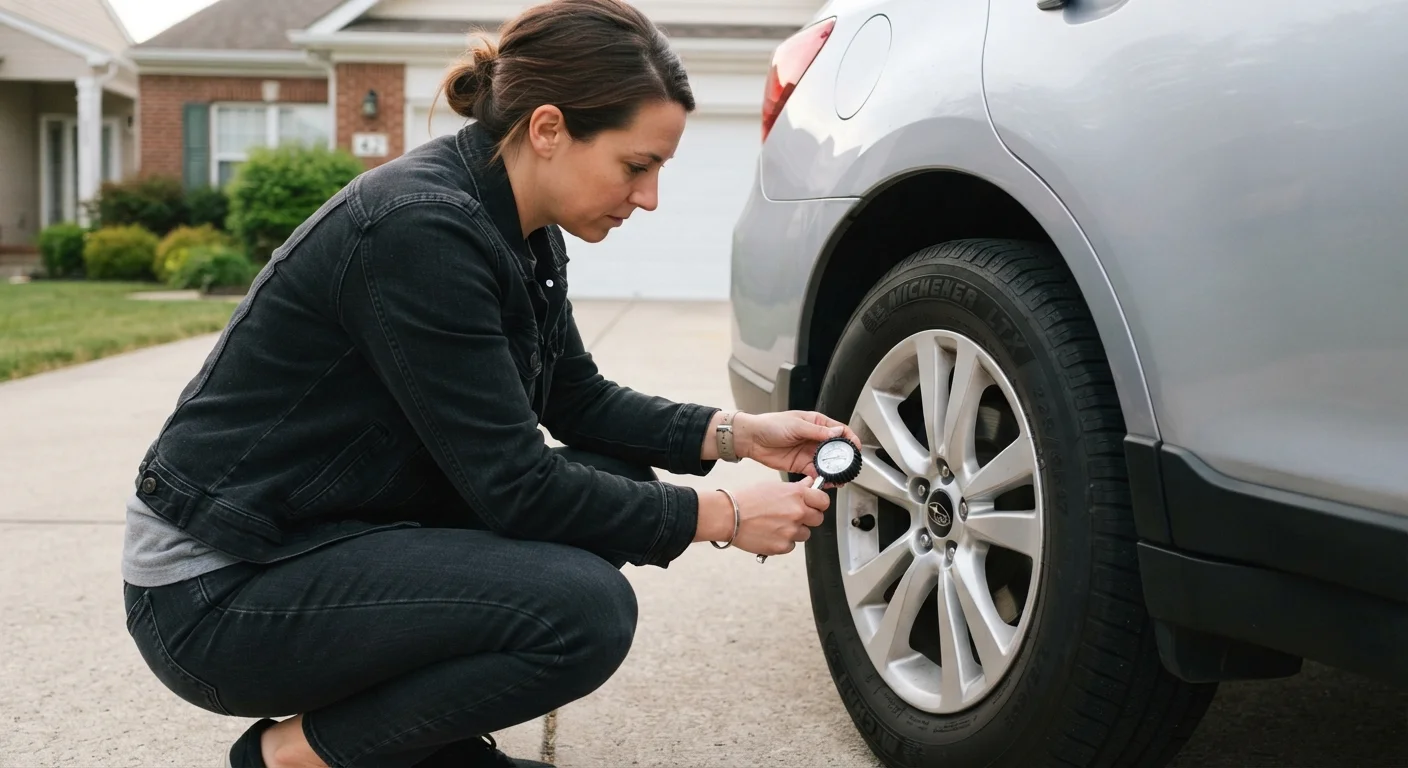
- Press a quality gauge firmly onto the stem and read the PSI.
- Add air at a gas station compressor or portable pump if the reading is low.
- Release air with the small pin inside the valve stem if the reading is too high.
- Replace the valve cap.
Temperature directly affects pressure. A drop of 10 degrees Fahrenheit causes a loss of roughly 1 PSI. This means tires that were properly inflated in late summer may be noticeably low by the first cold snap. Monthly checks account for this. For a full seasonal lens, seasonal tire and car care covers what to inspect at each transition.
Keep a gauge in the glove box
A quality digital or dial gauge is more reliable than the free gauges attached to gas station air hoses, which can give inaccurate readings. Keeping one in your glove box makes monthly checks easy and removes any excuse to skip them.
Reading tread depth and knowing when to replace
Tread depth is measured in 32nds of an inch. New passenger tires typically start at 10/32 to 11/32 inch. Most U.S. states set the legal minimum at 2/32 inch, but grip on wet roads deteriorates well before that point. Many tire professionals suggest considering replacement at 4/32 inch for drivers in rain-prone regions.
Two quick at-home checks:
- Penny test: Insert a penny into a tread groove with Lincoln's head facing down. If you see all of his head, the tread is at or below 2/32 inch.
- Quarter test: Same method with a quarter. If you see all of Washington's head, you are at or below 4/32 inch.
Check multiple spots across each tire: center, inner shoulder, and outer shoulder. Uneven wear patterns tell their own story. Wear concentrated in the center often points to chronic overinflation. Wear along both edges suggests underinflation. One-sided wear can indicate an alignment problem worth addressing at a shop.
Tires that are otherwise deep-treaded can still be unsafe. Sidewall cracking, bulges, or exposed cords are grounds for immediate replacement regardless of tread depth. A qualified mechanic should inspect any tire showing those signs.
If wet-road handling is a concern, adapting your driving in rain and snow explains how your habits need to adjust when tires are working hard.
Tire rotation: what it is and how often to do it
Rotation means moving each tire to a different position on the vehicle on a regular schedule. Front and rear tires wear at different rates because the front tires steer and, on front-wheel-drive vehicles, also handle acceleration. Without rotation, the more-stressed tires wear out significantly faster, forcing you to replace them while the others still have usable life.
Most vehicle manufacturers recommend rotation every 5,000 to 8,000 miles. Many drivers tie it to every oil change, which is a practical habit. Your owner's manual has the interval specific to your vehicle.
The rotation pattern (which tire goes where) depends on your drivetrain and whether your tires are directional or non-directional. A directional tire has a V-shaped tread designed to roll in one direction only; it can move front-to-back on the same side but cannot cross to the opposite side. Non-directional tires can cross. An all-wheel-drive vehicle may also have tighter rotation requirements to protect the differential. When in doubt, have a tire shop handle the rotation and confirm the pattern.
Rotation is also a good opportunity to inspect brakes and wheel hardware while the tires are off. Many shops include a visual inspection as part of the service. For a broader look at which tasks are reasonable to handle yourself versus when a shop is the smarter call, see DIY vs. shop maintenance.
Putting it all together in your maintenance routine
These three tasks work together. Correct pressure slows uneven wear. Rotation distributes that wear across all four tires. Regular tread checks tell you when the tires have given everything they can and replacement is due.
A simple schedule that works for most drivers:
- Check pressure monthly and before any long drive. A pre-trip checklist can help you build this into your departure routine.
- Rotate tires every 5,000 to 8,000 miles, or at each oil change.
- Inspect tread depth at each pressure check; look for uneven wear patterns.
Tire care is one of the lowest-cost, highest-impact areas of vehicle upkeep. The tools cost less than $20 (a quality gauge and a portable inflator), and the monthly time investment is under five minutes per vehicle. The habits compound over the life of a set of tires in fuel savings, longer tread life, and consistent road grip.
This article is for general informational purposes. For repairs, mounting, or any tire service involving vehicle lifting, consult a qualified tire or automotive professional.