
Why space buys you time
Every crash involving the front of one vehicle and the rear of another begins the same way: the trailing driver ran out of space before they could stop. Following distance converts physical space into time, and time is what a driver needs to perceive a hazard, decide to brake, and bring a vehicle to a full stop.
Stopping a moving vehicle is not a single action. It happens in stages. First, the driver must see that something is wrong (perception time). Then the brain must send the signal to move a foot from the accelerator to the brake (reaction time). Only then does actual braking begin. At 60 mph, the average driver travels roughly 60 to 90 feet during that perception-reaction window alone, before the brake even touches the rotors. Total stopping distance at that speed on dry pavement typically reaches 240 to 300 feet depending on the vehicle and road surface.
The three-second rule accounts for all of this. Because the gap is measured in time rather than car lengths or feet, it automatically adjusts as speed changes. A faster speed creates a longer physical gap but preserves the same time buffer, which is what matters for stopping.
See how following distance connects to broader safety habits in the habits that separate safe drivers from lucky ones.
How to apply the three-second rule correctly
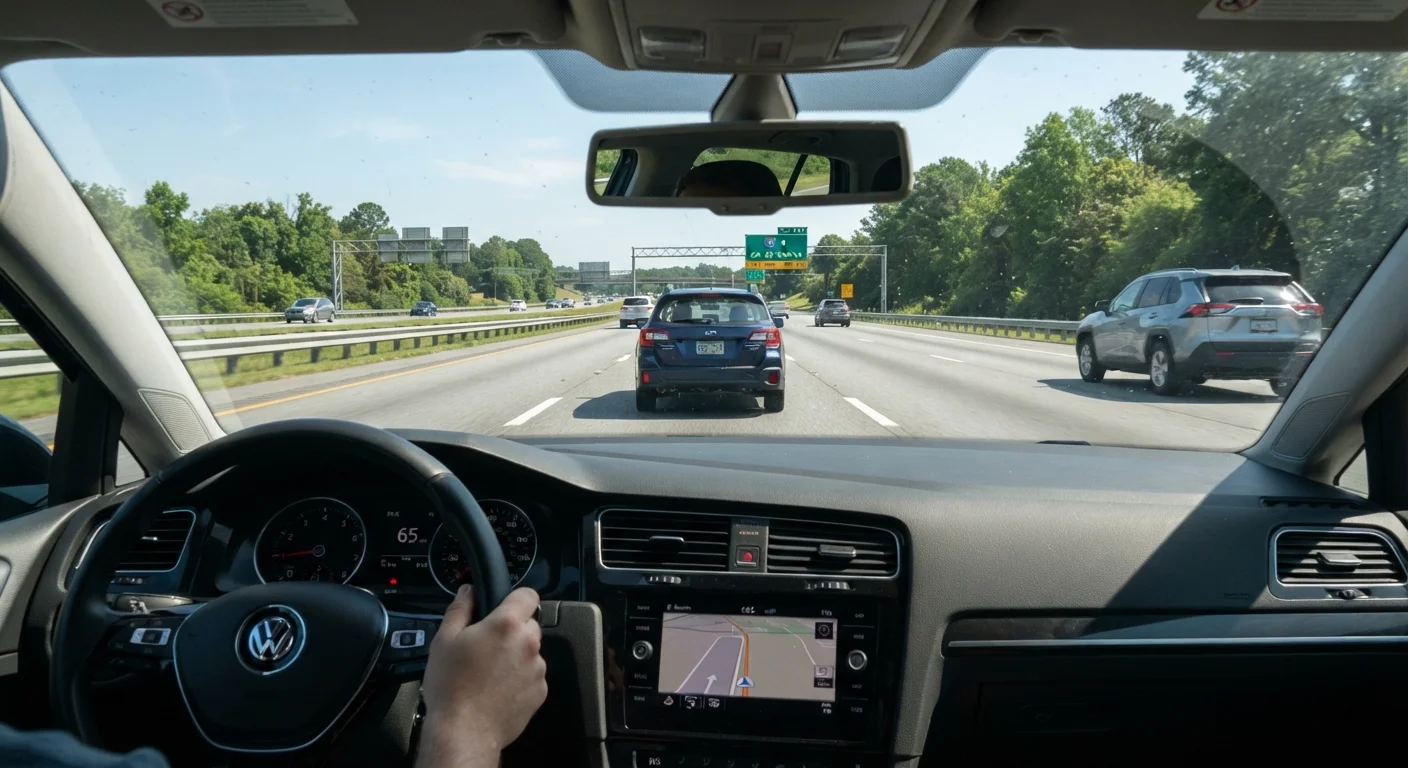
The method is straightforward. As the vehicle ahead of you passes a fixed object (a highway sign, a bridge pillar, a shadow line on the pavement), start counting: one-one-thousand, two-one-thousand, three-one-thousand. Your front bumper should not reach that same object before you finish.
Most drivers who try this discover they are following at one or two seconds, which is dangerously short. At 55 mph, one second equals about 80 feet. Two seconds gives roughly 160 feet. Neither is enough space when you account for an unexpected stop, a blown tire in the car ahead, or debris falling from a load.
Holding your gap in heavy traffic
When another driver cuts into the space you have left, ease off the accelerator gradually rather than braking sharply. Allow the gap to rebuild over several seconds. Smooth deceleration keeps traffic flowing and avoids startling the driver behind you.
The rule gets harder to apply when traffic is dense and other drivers fill any gap you open. Resist the pressure to close that gap just because another car moves into it. Adjust your position gradually and keep monitoring the space to the vehicle now in front of you.
When three seconds is not enough
Three seconds is a minimum for good conditions: dry pavement, full daylight, alert driver, standard passenger car. Several factors push that minimum higher.
Weather: Wet pavement lengthens braking distance significantly. Snow and ice can multiply it. In rain, four seconds is a reasonable floor. In snow or ice, six or more seconds may still leave a narrow margin. For a full breakdown of how to adjust speed and distance in poor weather, see driving in rain, snow, and fog.
Vehicle weight: A loaded pickup or SUV carries more momentum than an empty sedan. Commercial trucks can need up to 40 percent more stopping distance than a passenger car at the same speed. Drivers of larger or heavily loaded vehicles should add at least one second to their following gap as a baseline.
Reduced visibility: At night or in fog, the driver perceives hazards later, which effectively shrinks usable reaction time. An extra second or two compensates for that delayed perception. Night driving introduces risks that a daylight following-distance habit does not fully address.
Driver fatigue: A tired driver's reaction time increases measurably. If alertness is compromised, more space is the only mechanical buffer available until the driver can rest.
Following distance and defensive driving
Adequate following distance does more than provide stopping room. It gives the driver a wider visual field. When you sit close behind a large vehicle, your view of the road ahead disappears almost entirely. Pull back three or more seconds and you can see past or around the vehicle in front, spot brake lights two or three cars ahead, and respond earlier to hazards.
This is the logic behind defensive driving: acting on information before a situation becomes urgent, rather than reacting once it already is. A driver who maintains consistent following distance is rarely caught scrambling at the last second because they gave themselves the time to act deliberately.
29%
Share of U.S. crashes that are rear-end collisions
According to the National Highway Traffic Safety Administration, rear-end crashes are among the most common crash types on American roads.
240-300 ft
Typical stopping distance at 60 mph on dry pavement
This estimate covers the full sequence of perception, reaction, and braking for an alert driver in a standard passenger vehicle.
4-10x
Increase in braking distance on ice vs. dry road
Transportation safety data consistently shows that ice dramatically lengthens the distance needed to bring a vehicle to a complete stop.
Tailgating is a contributing factor in a significant share of rear-end crashes, which account for roughly 29 percent of all vehicle crashes in the U.S., according to the National Highway Traffic Safety Administration. Most of those crashes are preventable with adequate following distance and attentive driving.