
Why darkness changes the driving equation
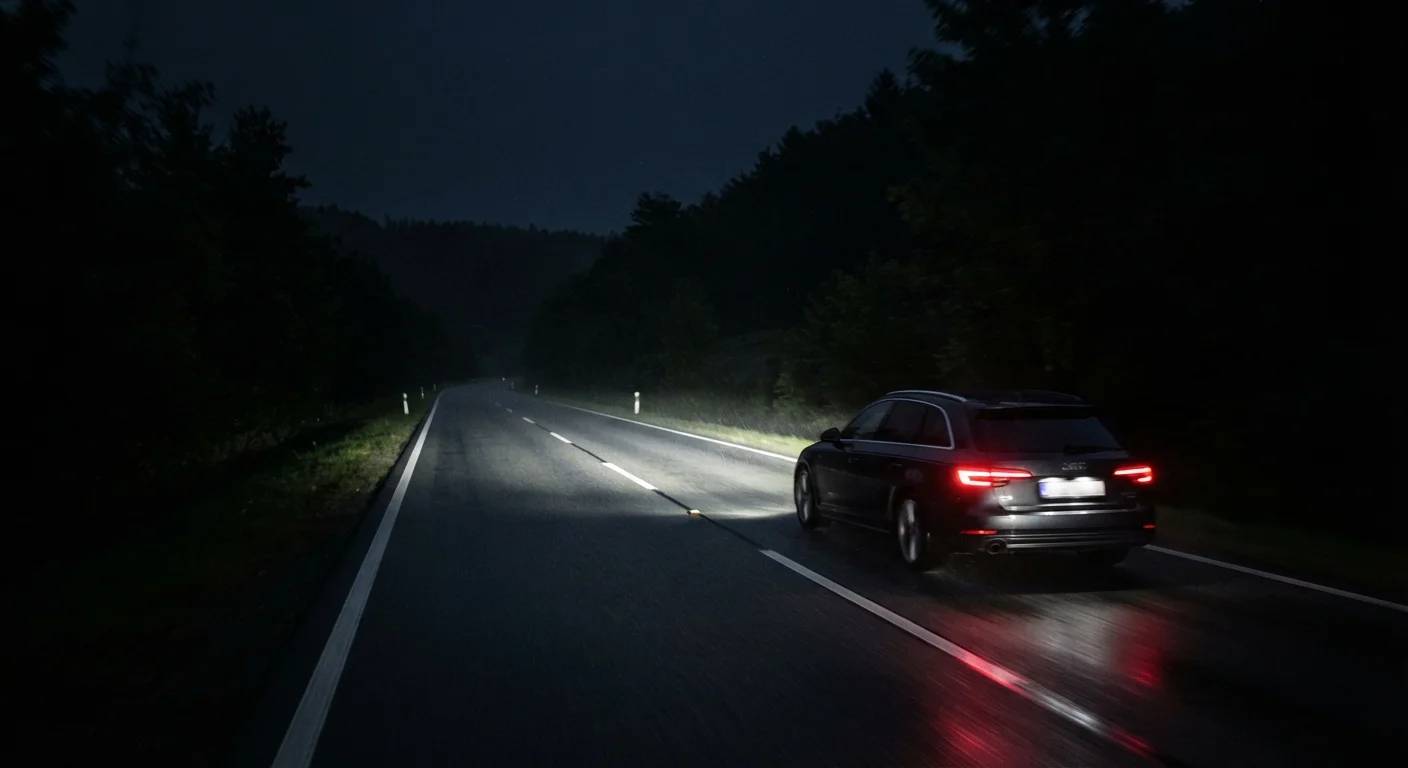
At night, your visual field narrows to whatever your headlights cover. Peripheral vision, which gives daytime drivers an early warning of pedestrians, cyclists, and merging vehicles, becomes nearly useless beyond the lit cone in front of you. Depth perception and color recognition also degrade in low light, making it harder to judge the speed and distance of other objects accurately.
The physics of stopping don't change after dark, but the information available to act on does. At 60 mph on low beams, a typical car's headlights illuminate roughly 200 feet ahead. Stopping from 60 mph takes closer to 240 feet when you account for reaction time. That gap means a hazard appearing at the edge of your headlight range may not leave enough distance to stop in time, a situation sometimes called overdriving your headlights.
The three-second following rule applies during the day, but at night a four- or five-second gap is more appropriate. Extra space buys time when you are reacting to something you saw only a fraction of a second ago.
The other drivers on the road after dark
Your own vision is one part of the night driving challenge. The behavior of others on the road is another. NHTSA data shows that alcohol-impaired driving fatalities are disproportionately concentrated in nighttime hours, particularly on weekends. Drowsy driving also peaks late at night and in the early morning, with many drivers unaware of how impaired their reaction times have become.
Recognizing these patterns matters for how you position yourself in traffic. Give unusually slow, weaving, or abruptly braking vehicles a wide berth. Avoid aggressive passing maneuvers that close your safety margins. A defensive driving mindset is always useful, but it becomes especially important when the likelihood of encountering an impaired or fatigued driver is higher.
Adjust your following distance after dark
The standard three-second rule is a daytime baseline. At night, especially on unlit roads, adding one to two seconds of additional gap gives you more time to identify and react to hazards at the edge of your headlight range. This is particularly important when following large vehicles whose taillights may obscure what is ahead of them.
Vehicle preparation for nighttime driving
Headlights degrade over time. Plastic lenses yellow and haze, cutting light output substantially. Bulbs dim before they fail outright. Misalignment, often caused by minor front-end impacts, can point light into the ditch or into oncoming drivers' eyes rather than down the road. Checking your headlights regularly and replacing or restoring them when output declines is one of the most direct ways to extend your sight distance at night.
Windshield cleanliness matters more than most drivers realize. A film of road grime on the inside of the glass scatters oncoming headlight glare into a diffuse haze that reduces contrast and makes it harder to pick out objects. Cleaning the inside of the windshield periodically, something easy to overlook, can make a noticeable difference.
Tire condition affects stopping distance regardless of the time of day, but the shorter reaction windows at night make adequate tread more important. See tire pressure, tread, and rotation basics for guidance on keeping tires in the condition they need to be in.
Managing fatigue on nighttime drives
Drowsiness is among the most underestimated hazards in driving. The body's circadian rhythm naturally promotes sleepiness between roughly midnight and 6 a.m., and again in the early afternoon. Driving during those hours without adequate prior sleep significantly raises the chance of a microsleep event, a brief, involuntary loss of consciousness that can last several seconds.
Caffeine can delay the onset of fatigue but doesn't eliminate it, and its effect fades. The only reliable countermeasure for serious drowsiness is sleep. On long overnight drives, scheduling a stop every 90 to 120 minutes and taking a short nap of 20 minutes when fatigue sets in is more effective than pushing through.
If you are planning an extended night drive, the pre-trip safety checklist includes fatigue management as part of overall trip preparation. Treating rest as a safety requirement rather than a convenience is a habit that protects both you and others on the road. For a broader look at the habits that consistently reduce crash risk, see what separates safe drivers from lucky ones.