
What each mindset actually means
Defensive driving and reactive driving describe two fundamentally different relationships between a driver and the road ahead. A defensive driver is constantly scanning for conditions that could become problems: a car braking two vehicles ahead, a pedestrian stepping toward the curb, a merge lane closing. The goal is to have a plan before the situation demands one.
A reactive driver, by contrast, responds to hazards as they present themselves. This is not necessarily careless, but it is passive. Without an advance scan, the driver enters each situation with minimal time to decide and act. In calm, predictable traffic, the gap between these two approaches may be invisible. When a hazard materialises quickly, that gap can be the difference between a near-miss and a collision.
The National Highway Traffic Safety Administration (NHTSA) has consistently tied driver behavior, including inattention and failure to anticipate, to a large share of crash-contributing factors. Reactive driving does not cause inattention on its own, but it leaves no buffer when attention lapses even briefly.
Where the two approaches diverge in practice
The clearest practical difference shows up in how each driver uses space and time on the road. A defensive driver treats following distance as an information tool, not just a safety cushion. A larger gap gives more time to read what the vehicle ahead is doing and to adjust before emergency braking becomes necessary. The three-second rule exists precisely to give drivers this buffer.
A reactive driver tends to let following distance shrink with traffic flow, filling the gap because it feels natural rather than calculating whether the space provides adequate stopping time. When the car ahead brakes hard, the reactive driver is now managing an emergency rather than a routine adjustment.
| Criterion | Defensive Driving | Reactive Driving |
|---|---|---|
| Hazard awareness | Scans ahead and anticipates | Responds when hazard appears |
| Following distance | Maintained as a deliberate buffer | Adjusted by traffic flow feel |
| Speed in poor conditions | Reduced proactively | Reduced when conditions force it |
| Mirror checks | Regular timed intervals | Prompted by intended maneuvers |
| Escape route planning | Identified before a hazard develops | Sought during the hazard |
| Response time margin | Built in through space and scan | Depends on how quickly hazard appears |
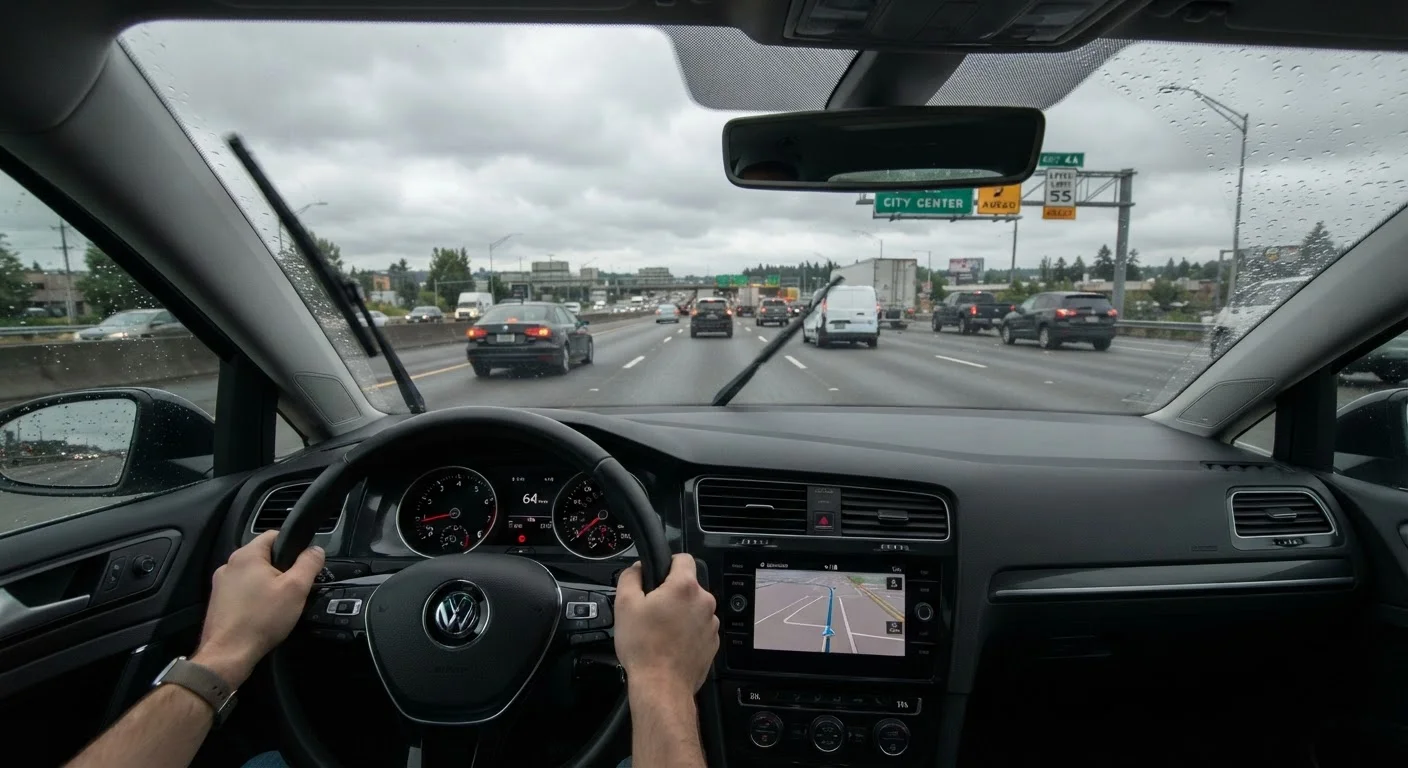
Speed management shows a similar split. Defensive drivers adjust their speed to match road conditions, not just posted limits. In rain or reduced visibility, that means slowing even when other drivers do not. Adjusting for weather conditions is a natural extension of defensive thinking. Reactive drivers often maintain highway speed until a condition forces a change.
Mirror checks and blind-spot awareness follow the same pattern. Defensive drivers scan mirrors on a regular interval, typically every five to eight seconds, so they always have a current mental picture of surrounding traffic. Reactive drivers check mirrors when a lane change or maneuver prompts them to.
Why reactive driving persists even among experienced drivers
Most drivers learn reactive habits early and never fully replace them. Driving school teaches rules and mechanics; it teaches anticipation less systematically. Over time, drivers develop pattern recognition that can mimic anticipation, but pattern recognition is only useful when the current situation matches a familiar pattern. Novel hazards, like a stationary vehicle on a highway, an unexpected merge, or a cyclist appearing from a driveway, can catch even experienced reactive drivers flat-footed.
There is also a confidence problem. Years without a serious incident can lead a driver to interpret reactive habits as sufficient. The habits that separate safe drivers from lucky ones examines this distinction directly: good outcomes do not always mean the approach was sound.
Distraction compounds the problem. A reactive driver who is also managing divided attention has almost no buffer at all. Common misconceptions about distraction show that many drivers overestimate their ability to manage multiple inputs while driving.
Building defensive habits that stick
Defensive driving is not a personality trait. It is a set of specific behaviors that can be practiced deliberately until they become automatic. The core habits are consistent mirror scanning, maintaining adequate following distance, adjusting speed to conditions, and identifying an escape route before a hazard forces one. That last point separates experienced defensive drivers from beginners: they do not just see the hazard, they already know where they would go if they needed to move.
Night driving is a good test case for defensive habits. Reduced visibility means hazards appear closer to the driver before they are detectable, which compresses the time available to react. Drivers who are already scanning systematically and maintaining larger following distances adapt to night conditions more naturally than those who rely on reactive responses.
Formal defensive driving courses, available through many driving schools and some insurance programs, offer structured practice. They are not only for new drivers or those with violations. Completing a course is one of the more direct ways to audit and correct habits that have drifted toward reactive over time.